How Governments Became Major Crypto Holders 27/01/2026


Countries That Hold the Most Bitcoin: How Governments Became Major Crypto Holders
Countries That Hold the Most Bitcoin
Bitcoin started as a decentralized, borderless digital currency designed to operate outside the control of governments. Ironically, more than a decade later, several governments now hold large amounts of Bitcoin, either intentionally as part of national strategy or unintentionally through law enforcement actions. These holdings matter because they influence market sentiment, national crypto policy, and even geopolitical positioning in the digital economy.
Below is a clear look at the countries that currently hold the most Bitcoin, how they acquired it, and why it matters.
United States
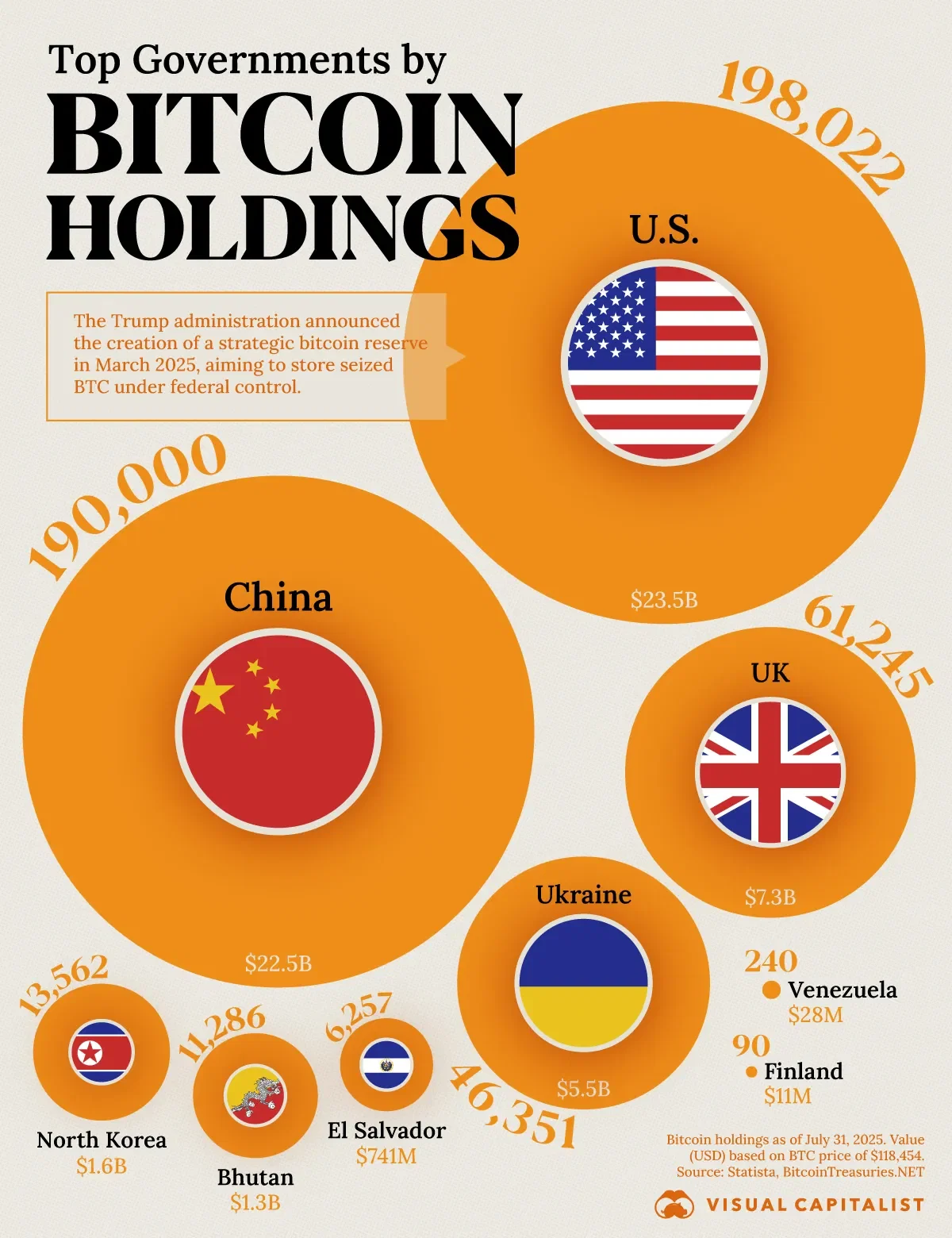
The United States is widely believed to be the largest government holder of Bitcoin in the world. Unlike countries that actively buy Bitcoin for reserves, most US holdings come from seizures related to criminal investigations, darknet markets, ransomware cases, and financial fraud.
High-profile cases such as the Silk Road seizure added tens of thousands of Bitcoins to government wallets. These assets are typically managed by federal agencies and, over time, auctioned to the public rather than held as long-term reserves. Still, until sold, they count as government-held Bitcoin.
What makes the US position unique is its indirect influence on the market. When authorities announce plans to sell seized Bitcoin, prices often react. This gives the US government a quiet but powerful role in Bitcoin liquidity and market psychology, even though it does not officially recognize Bitcoin as a reserve asset.
China
China once dominated global Bitcoin mining, but its relationship with Bitcoin has been complicated. The Chinese government officially banned cryptocurrency trading and mining, yet it still holds a substantial amount of Bitcoin, mainly from past seizures and enforcement actions.
One of the largest known seizures occurred after the shutdown of the PlusToken scam, which left authorities with a massive crypto stash. While China rarely discloses exact figures or wallet addresses, blockchain analysts estimate that its Bitcoin holdings remain among the largest in the world.
Unlike the US, China is highly opaque about what it does with seized Bitcoin. There is no clear record of public auctions or liquidation strategies. This uncertainty adds an extra layer of speculation to the market, as any future sale could significantly affect prices.
Germany
Germany holds Bitcoin primarily through law enforcement seizures, similar to the US. However, what sets Germany apart is its more transparent approach. In recent years, German authorities have openly transferred and sold Bitcoin obtained from criminal cases.
These sales have drawn attention because they signal a pragmatic view of Bitcoin as a financial asset rather than an ideological threat. Germany does not treat Bitcoin as legal tender, but it does recognize it as private money under certain legal frameworks.
The country’s approach reflects a broader European stance where Bitcoin is regulated, taxed, and monitored, but not outright rejected. This middle-ground policy makes Germany one of the more influential Bitcoin-holding countries in Europe.
El Salvador
El Salvador is the most famous example of a country that intentionally holds Bitcoin as part of national policy. In 2021, it became the first country in the world to adopt Bitcoin as legal tender.
Since then, El Salvador has regularly purchased Bitcoin for its national treasury, often announcing buys during market dips. These purchases are relatively small compared to US or Chinese holdings, but they are symbolically massive.
El Salvador’s strategy is long-term. The government views Bitcoin as a hedge against inflation, a tool for financial inclusion, and a way to attract foreign investment. While the policy has been controversial and risky, it has positioned El Salvador as a global reference point in state-level Bitcoin adoption.
Ukraine
Ukraine emerged as a notable Bitcoin-holding country after receiving large crypto donations during the Russia–Ukraine conflict. Individuals and organizations worldwide donated Bitcoin and other cryptocurrencies to support defense and humanitarian efforts.
While much of this Bitcoin was spent rather than stored, Ukraine’s government officially acknowledged crypto as a funding mechanism and integrated it into its financial infrastructure. This made Ukraine one of the first countries to actively use Bitcoin in a wartime context.
Ukraine’s case shows that Bitcoin is not just a speculative asset but also a practical financial tool during crises.
Why Government Bitcoin Holdings Matter
When governments hold Bitcoin, it changes the narrative. Bitcoin shifts from being purely a grassroots financial experiment to a strategic asset with national and geopolitical implications.
Large holders can influence prices, shape regulations, and legitimize Bitcoin in the eyes of institutions. At the same time, government sales or policy reversals can introduce volatility and uncertainty.
Some countries treat Bitcoin as confiscated property, others as an investment, and a few as a monetary alternative. This diversity shows that Bitcoin’s role is still evolving, and national strategies are far from settled.
Final Thoughts
The countries that hold the most Bitcoin did not all arrive there for the same reasons. Some seized it, some invested in it, and others received it out of necessity. Together, they demonstrate that Bitcoin has crossed a critical threshold. It is no longer just held by individuals and companies but by states themselves.
As adoption grows and regulations mature, government-held Bitcoin will remain one of the most closely watched forces shaping the future of the crypto market.